Update on Polio Eradication Efforts in Afghanistan
Monthly Snapshot - March 2026
Epidemiology
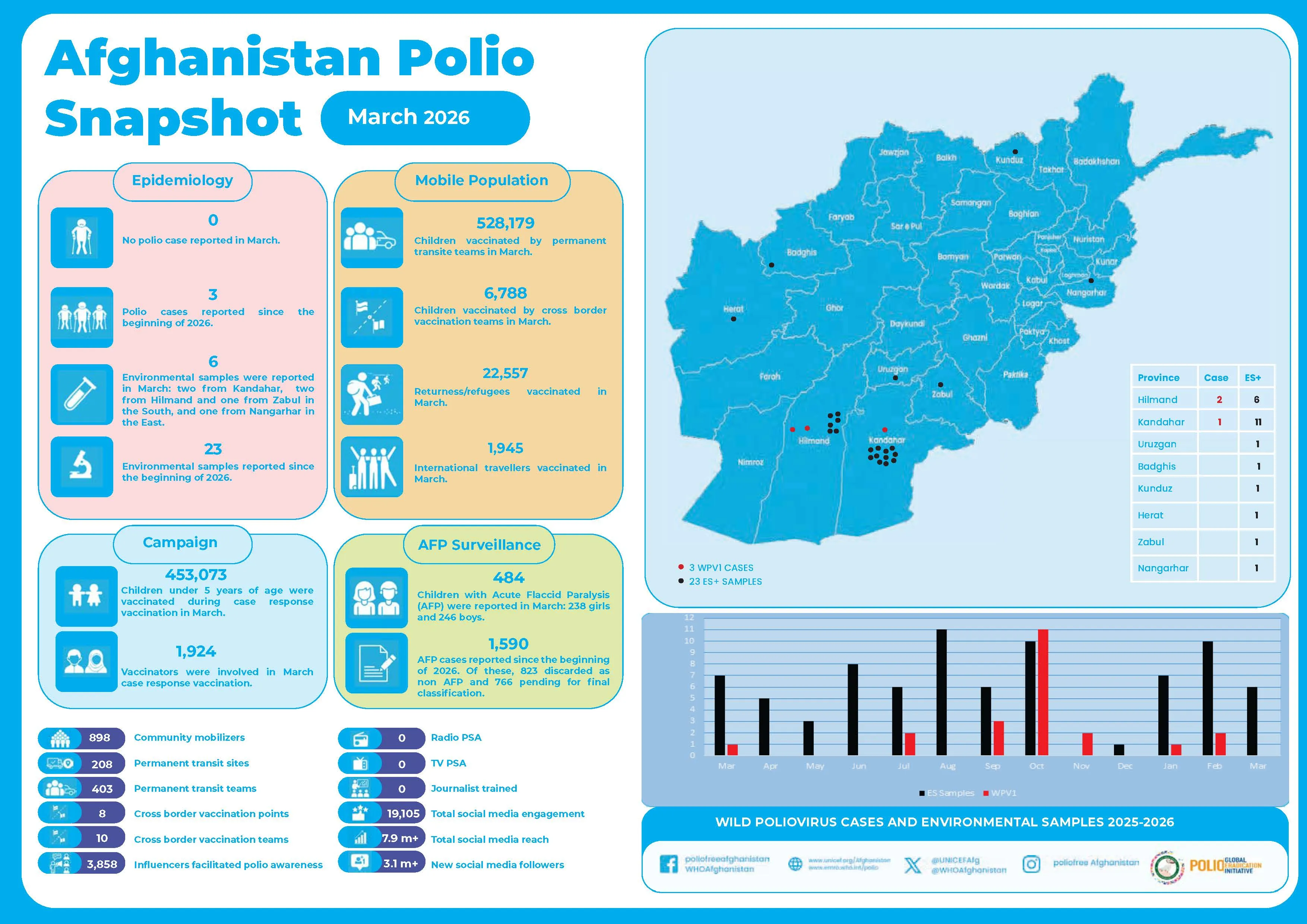
Afghanistan reported no new wild poliovirus (WPV1) cases in March 2026. However, since the beginning of the year, 3 confirmed WPV1 cases have been recorded.
Environmental surveillance continued to detect poliovirus circulation in high-risk areas. During March, 6 positive environmental samples were reported, including 2 from Kandahar, 2 from Hilmand, 1 from Zabul in the South, and 1 from Nangarhar in the East. Since the beginning of 2026, a total of 23 positive environmental samples have been detected nationwide.
Mobile Population
The programme continued to vaccinate children on the move to reduce the risk of cross-border and internal transmission of poliovirus.
During March:
| • | 528,179 children were vaccinated by permanent transit
teams. |
| • |
6,788 children received polio vaccine through
cross-border vaccination teams. |
| • |
22,557 returning refugees were vaccinated upon their
return to Afghanistan. |
| • |
1,945 international travellers received polio vaccine
at designated vaccination points. |
Campaign
As part of case response vaccination, the programme conducted targeted vaccination campaigns in areas at risk of poliovirus transmission.
During March, 453,073 children under five years of age were vaccinated through case response vaccination activities, with the support of 1,924 vaccinators deployed across the affected areas.
AFP Surveillance
Acute Flaccid Paralysis (AFP) surveillance remained robust during the reporting period.
In March, 484 AFP cases were reported, including 238 girls and 246 boys.
Since the beginning of 2026, 1,590 AFP cases have been reported nationwide. Of these, 823 cases have been discarded as non-polio AFP, while 766 cases remain pending final classification.
Programme Indicators
The Afghanistan Polio Eradication Initiative maintained a strong operational network to support vaccination, surveillance and community engagement activities.
As of March 2026, the programme included:
898 community mobilizers.
| • | 898 community mobilizers. |
| • |
208 permanent transit sites. |
| • |
403 permanent transit teams. |
| • |
8 cross-border vaccination points. |
| • |
10 cross-border vaccination teams. |
| • |
3,858 community influencers supporting polio
awareness activities. |
During March:
| • | 0 radio public service announcements (PSAs) were
aired. |
| • |
0 television PSAs were broadcast. |
| • |
0 journalists received training. |
Across digital platforms, the programme generated:
| • | 19,105 total social media engagements. |
| • |
More than 7.9
million people reached. |
| • |
More than 3.1
million new social media followers. |
Wild Poliovirus Cases and Environmental Samples (2025–2026)
From 2025 through March 2026, wild poliovirus cases and positive environmental samples were reported from several provinces.
Province |
WPV1 Cases |
Positive Environmental
Samples |
| Hilmand | 2 | 6 |
| Kandahar | 1 | 11 |
| Uruzgan | 1 | - |
| Badghis | 1 | - |
| Kunduz | 1 | - |
| Herat | 1 | - |
| Zabul | 1 | - |
| Nangarhar | 1 | - |
Key Highlights
| • | 0 wild poliovirus cases were reported in March
2026. |
| • |
3 confirmed WPV1 cases have been reported since
the beginning of 2026. |
| • |
6 positive environmental samples were detected
during March. |
| • |
23 positive environmental samples have been
reported since January 2026. |
| • |
453,073 children were vaccinated during case response
vaccination activities. |
| • |
484 AFP cases were reported during the month. |
| • |
The programme
continued to maintain strong surveillance, vaccination and community engagement
activities across the country while responding to ongoing poliovirus
transmission detected through environmental surveillance. |